


LockThreat Technical Support Policy
Effective Date: June 26, 2025
Last Updated Date: August 7, 2026
Applies To: All customers of LockThreat using SaaS or On-Premise deployments
1. Introduction
At LockThreat, our mission is to deliver high velocity, low friction support and service that ensures minimal disruption to your operations and maximized business outcomes. This policy outlines the scope, processes, and expectations for accessing technical support across our product portfolio.
2. Support Availability & Plan Levels
We offer three tiers of support to match the needs of your organization: Essential, Professional, and Enterprise. Each level includes different services and response channels to ensure that customers receive the appropriate level of service.
Support Tier Comparison:
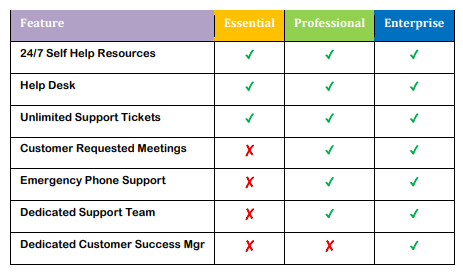
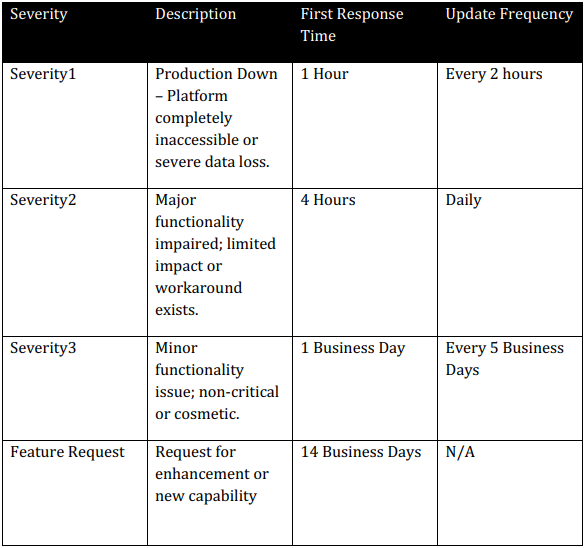
3. Service Level Agreements (SLA's) During Business Hours
4. Definitions
Break/Fix: Malfunction of previously working functionality that now needs repair.
Severity Definitions:
- Severity1 (Critical): The software is completely non-functional, resulting in a total system outage or failure. There is no workaround available, and it impacts all users, halting critical business operations.
- Severity2 (High): The software is significantly degraded, causing major disruptions to business operations. A workaround may exist, but the problem must be resolved quickly to prevent further impact
- Serverity3 (Medium): The software is functioning with some issues that may affect a limited number of users or features. The issue is inconvenient but does not severely disrupt normal business operations. A workaround is often available.
- Feature Request: Non-urgent enhancement or new capability.
5. Scope of Support
Support includes: Troubleshooting errors, Configuration guidance, Performance analysis, Patch/version updates.
Support excludes: Custom code issues, Non-managed integrations, End-user training, Customer-driven infrastructure issues.
6. Change Management Policy
Customer-Made Changes: LockThreat is not liable for issues caused by customer changes to:
- Infrastructure or environment (on-prem)
- Database schema
- Third-party systems
Best Practice: Notify us of any planned changes at least 3 business days prior for a risk review.
7. Incident Management Process
1. Submit a Ticket via the portal at support.lockthreat.com
2. Classify (S1–S3, Feature Request)
3. Triage & Response based on SLA
4. Resolve or Provide Workaround
5. Customer Confirmed Closure (or 5 days if no Customer response)
8. Customer Responsibilities
- Assign a primary technical contact
- Ensure timely communication with LockThreat Support
- Maintain a stable environment for on-premise customers
- Do not alter core configurations or code without support engagement
9. Escalation Path
Level 1: Support Team Leader
Level 2: Director, Customer Experience
Level 3: Chief Customer Officer
10. Maintenance and Updates
SaaS Customers: Maintenance performed during announced windows. Emergency patches applied with 1-hour notice.
On-Premise Customers: Semi-annual upgrade packages provided.
11. Version Support Policy
To ensure the highest levels of stability, security, and performance, LockThreat provides support for the current software version and the two preceding minor versions. For example, if the latest release is 3.3.2, customers running 3.3.0 or later will continue to receive full support.
Customers operating on versions older than two minor releases behind will be required to engage LockThreat Professional Services for upgrade assistance. This ensures that any potential complexities introduced by older versions are addressed seamlessly and without disruption.
Hotfixes will be issued only for the current version and the two preceding minor versions. Customers running unsupported versions must first upgrade to an eligible version before receiving hotfixes or other maintenance updates.
12. Ticket Resolution for Version-Specific Issues
If a customer submits a support ticket for an issue that has already been fixed or resolved in the current release of LockThreat, but the customer is not running the current version, the ticket will be closed as resolved. Customers are encouraged to upgrade to the latest supported version. Should the issue persist after upgrading, the customer may open a new ticket, and LockThreat Support will investigate and resolve accordingly.
13. Customer Responsiveness During Troubleshooting
During the troubleshooting process, LockThreat Support may require input, confirmation, or testing from the customer to progress the case. If the customer does not respond to repeated requests for information within five (5) business days, the ticket will be closed. Customers are welcome to open a new ticket at any time should the issue remain unresolved.
14. Ticket Reopening Policy
Customers may reopen any closed ticket within five (5) business days of closure if the issue reoccurs or additional details become available. After this period, customers should open a new ticket to ensure timely handling and accurate tracking.
15. Feature Requests
Feature ideas are reviewed quarterly and prioritized based on:
- Regulatory compliance needs
- Customer impact
- Strategic value
- Product roadmap alignment
16. Security and Compliance
LockThreat treats security incidents as S1 and follows strict incident management protocols.
17. Suspension of Services
LockThreat reserves the right to suspend any and all services due to non-payment of invoices older than sixty (60)days. Suspension of services may include, but is not limited to, interruption of anti-virus, backups, patching, email filtering, data monitoring, event log monitoring – all with respect to Customer’s use of Software, and other services as determined by LockThreat at the time of suspension. In the event of non-payment of invoices older than sixty (60) days, LockThreat has the right to retain and/or change all passwords for Customer’s managed services.
18. Contact Information
Support Portal: support.lockthreat.com
Email: support@lockthreat.com
Phone (Critical Only): 877-423-8644
Customer Success Manager: csm@lockthreat.com
19. Policy Review
This policy is reviewed semiannually.Material changes will be communicated in advance.



.png)
.png)